

Residential Design
Residential Renovation: 大埔圍頭村
Unit area: sq. ft.
Project Description
Speaking of the 50-year-old ancestral house in Weitou Village, people may think of dilapidated houses surrounded by barbed wire. However, after careful design by the designer, this village house was transformed and renovated into a Japanese-style residence. It not only improved the aesthetics, but also allowed the elderly homeowners and their families to better adapt to the new environment and improve the convenience of life.
This village house covers an area of 3,000 square feet and is divided into a two-story large house and a one-story cottage. The owners are an elderly mother-in-law and a young couple. The renovation project lasted for one year and focused on improving the space planning to make life more convenient for the two generations of owners.
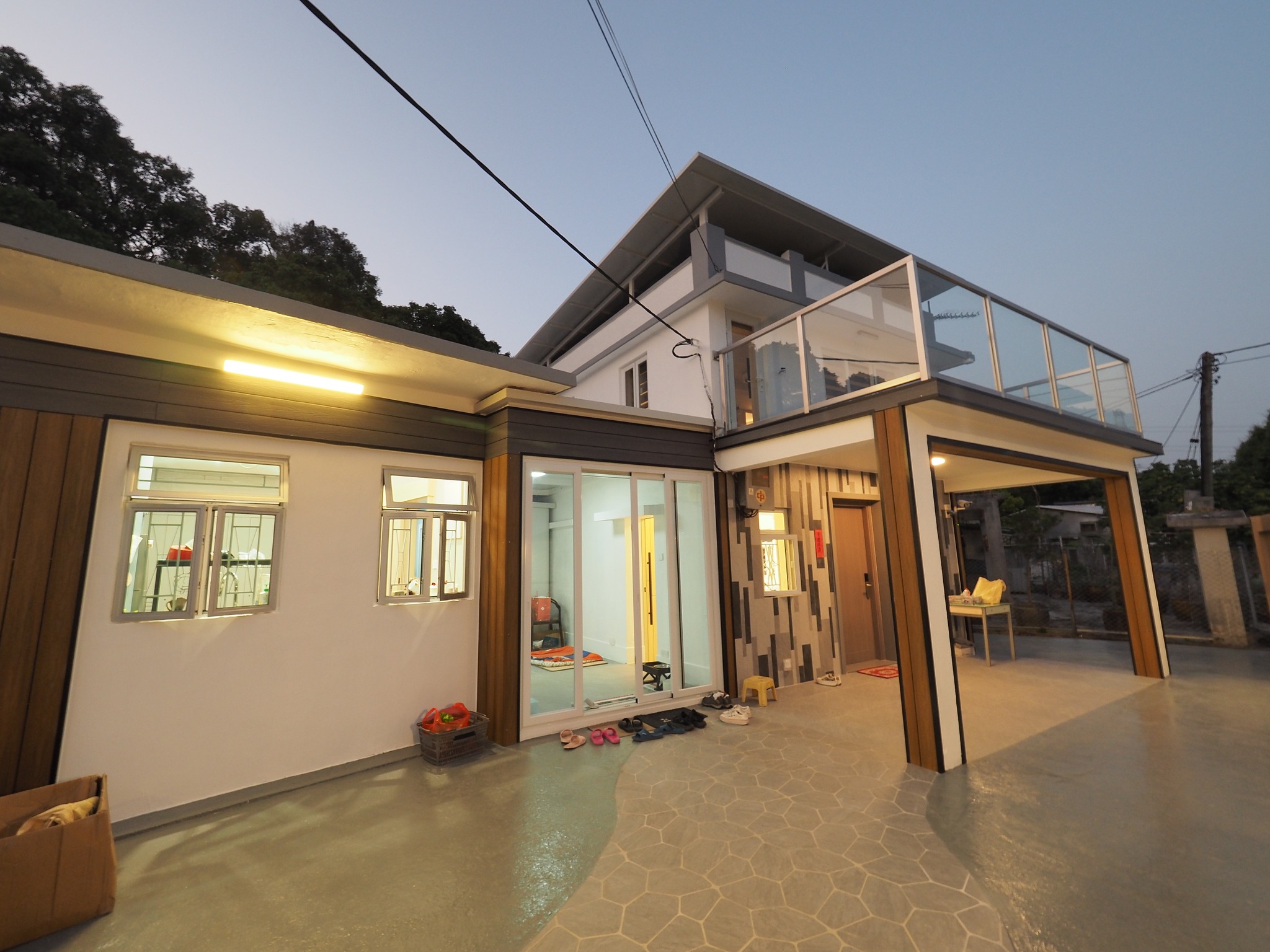
This village house was built in 1984 and is being renovated for the first time. The exterior design uses a large number of outdoor wooden strips and two feature walls, successfully creating a Japanese-style atmosphere. Bricks are used to lay flat gravel paths underground, which are not only beautiful but also convenient for elderly homeowners to walk.
In order to avoid monotony, the door is laid with irregular gray bricks, creating a visual effect of different shades and adding character to the doorway. A canopy is also designed between the big house and the cottage, and glass doors are used to maximize the use of space and allow natural light to fully enter the home.
Initially, there was only one toilet in the hut in the entire village. The owner had to walk to the hut to take a shower and then return to the big house, which was very inconvenient. The designer added two new toilets based on the owner's request. Different from ordinary residential buildings, due to the special structure of the village house, a new toilet needs to dig a septic tank underground and connect it to the pipes of the village house to ensure that the new toilet can operate normally without producing odor. This modification will test the designer's design and knowledge and experience in modifying toilets, pipes, etc. Finally, the new design provides a toilet on the upper floor, lower floor and cabin of the big house, which greatly improves the convenience of the owner's life.
The living room is mainly my mother-in-law’s living space. Therefore, the color scheme is similar to the old design. Simple white is mainly used to comply with my mother-in-law’s preferences and make it easier for her to adapt to the new design. There are two beams in the living room. The designer cleverly designed a U-shaped light trough, which makes the beams functional and makes the living room more beautiful. In order to facilitate the entry and exit of the elderly, sliding doors are used in many places in the house. There are no steps from the elderly's bedroom to the living room and to the toilet. The bathroom is also designed with a barrier-free bath screen, making mother-in-law and family members feel more at ease when using it.
The couple's bedroom is located on the upper floor. Because they wanted to have a private space, the designer designed a ghost sliding door to effectively separate the space upstairs and the living room. Even if guests come to visit the mother-in-law, they will not disturb the couple's daily routine. In terms of color, the couple likes European and American styles. Therefore, the designers chose wood colors in white and red tones to match their preferences and contrast with the living room.
This renovation of the ancestral house in Wai Tau Village not only improved the appearance of the village house, but also made the lives of the two generations of owners more convenient. From space planning to the design of different areas, everything meets the needs and preferences of the homeowners to create their ideal home.